Evolution of Text Embeddings: From Words to Documents
Evolution of Text Embeddings: From Words to Documents
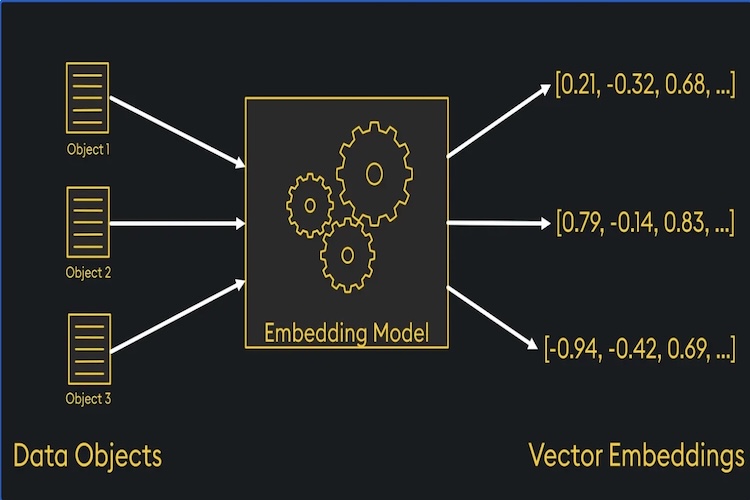
Text embeddings convert language into numerical vectors that machines can understand. Over time, embeddings evolved from representing individual words to sentences and full documents, significantly improving contextual understanding and downstream NLP performance.
Below is a brief overview of how text embedding techniques have evolved over time.
1. Word Embeddings (First Generation)
GloVe (Global Vectors for Word Representation)
Created by: Stanford University Research
GloVe is one of the earliest widely adopted word embedding methods. It learns word representations by leveraging global word co-occurrence statistics from large corpora such as Wikipedia and Gigaword.
GloVe is effective for capturing semantic similarity but does not understand context dynamically (static embeddings).
The following Python code sample loads pre-trained GloVe embeddings and retrieves the vector representation of the word “king”.
1
2
3
4
from gensim.downloader import load

glove = load("glove-wiki-gigaword-300")
vector = glove["king"]
Key characteristics:
- Static word embeddings (same vector for each word)
- Strong at semantic similarity tasks
- Trained on large corpora (e.g., Wikipedia and Gigaword)
- Typical embedding dimension: 50–300
Word2Vec
Created by: Google Research
Word2Vec introduced neural network–based embeddings using CBOW (Continuous Bag of Words) and Skip-Gram architectures. It became one of the foundational techniques in modern NLP for learning distributed word representations.
The following Python code sample loads pre-trained Word2Vec embeddings and retrieves the vector representation of the word “computer”.
1
2
3
4
from gensim.downloader import load

w2v = load("word2vec-google-news-300")
vector = w2v["computer"]
Key characteristics:
- Learns word relationships via prediction tasks
- Captures analogies (king - man + woman ≈ queen)
- Static embeddings (no context awareness)
- Trained on the Google News corpus
- Typical embedding dimension: 300
FastText
Created by: Facebook AI Research (FAIR)
FastText extends Word2Vec by representing words as character n-grams. This allows the model to better handle rare words, misspellings, and morphologically complex languages.
The following Python code sample trains a simple FastText model and retrieves the vector representation of the word “processing”.
1
2
3
4
from gensim.models import FastText

model = FastText(sentences=[["natural", "language", "processing"]], vector_size=100)
vector = model.wv["processing"]
Key characteristics
- Uses subword (character n-gram) information
- Better handling of out-of-vocabulary words
- Still static embeddings
- Useful for morphologically rich languages
2. Sentence Embeddings (Second Generation)
BERT (Bidirectional Encoder Representations from Transformers)
Created by: Google AI
BERT introduced deep contextual embeddings using the Transformer architecture.
Unlike earlier models, the meaning of a word changes depending on the context in which it appears.
The following Python code sample loads a pre-trained BERT-based sentence embedding model and generates a vector representation for the sentence “Machine learning is fascinating”.
1
2
3
4
from sentence_transformers import SentenceTransformer

model = SentenceTransformer("bert-base-nli-mean-tokens")
embedding = model.encode("Machine learning is fascinating")
Key characteristics
- Context-aware (bidirectional understanding)
- Transformer-based architecture
- Strong performance in NLP benchmarks
- Embedding dimension: 768
DistilBERT
Created by: Hugging Face
DistilBERT is a compressed version of BERT created using knowledge distillation, a technique where a large model teaches a smaller model to perform similarly. It retains most of BERT’s performance while being faster and lighter.
The following Python code sample loads a pre-trained DistilBERT-based sentence embedding model and generates a vector representation for the sentence “AI is transforming industries”.
1
2
3
4
from sentence_transformers import SentenceTransformer

model = SentenceTransformer("distilbert-base-nli-stsb-mean-tokens")
embedding = model.encode("AI is transforming industries")
Key characteristics
- Faster and smaller than BERT
- Retains contextual understanding
- Suitable for production-scale applications
- Embedding dimension: 768
SISTER (Simple SenTence EmbeddeR)
Created by: Community-driven Python ecosystem (built on fastText-style embeddings; commonly used in lightweight NLP pipelines)
SISTER generates sentence embeddings by averaging word vectors (typically fastText-based), making it efficient but less context-aware than transformer models.
The following Python code sample loads a SISTER sentence embedding model and generates a vector representation for the sentence “Natural language processing is evolving”.
1
2
3
4
import sister

model = sister.MeanEmbedding(lang="en")
embedding = model("Natural language processing is evolving")
Key characteristics
- Lightweight and fast
- Limited contextual understanding
- Built on word-vector aggregation
- Typical dimension: 300
3. Text / Document Embeddings (Modern Generation)
Modern embedding models generate vector representations for words, sentences, paragraphs, or entire documents while capturing deeper semantic meaning and context.
These models are typically built using Transformer architectures and trained on very large datasets.
They power many modern AI applications including:
- Semantic search
- Recommendation systems
- Document clustering
- Question answering
- Retrieval-Augmented Generation (RAG)
- Vector database retrieval
Unlike early word embeddings, modern embeddings capture context across longer text, making them well suited for enterprise AI systems.
Common Characteristics
- Context-aware semantic representations
- Support for multiple text lengths (word → document)
- High-dimensional vectors optimized for similarity search
- Easy integration with APIs and vector databases
OpenAI Text Embeddings (text-embedding-ada-002)
Created by: OpenAI
One widely used implementation of modern text embeddings is text-embedding-ada-002, available through the OpenAI API. It generates dense vector representations used in semantic search, document retrieval, clustering, and recommendation systems.
The following Python code sample uses the OpenAI API to generate a text embedding for the sentence “Artificial intelligence is transforming businesses”. The model converts the input text into a high-dimensional numerical vector that can be used for tasks such as semantic search, similarity comparison, clustering, and retrieval systems.
1
2
3
4
5
6
7
8
9
10
from openai import OpenAI

client = OpenAI()

emb = client.embeddings.create(
    model="text-embedding-ada-002",
    input="Artificial intelligence is transforming businesses"
)

vector = emb.data[0].embedding
Newer embedding models have been introduced with improvements in accuracy, efficiency, and multilingual capability.
OpenAI (text-embedding-3-small)
Created by: OpenAI
A newer OpenAI embedding model optimized for cost-efficient semantic search and large-scale retrieval systems.
Key characteristics
- Embedding dimension: 1536
- Optimized for high-volume semantic search
- Lower cost than earlier models
- Compatible with most vector databases
OpenAI (text-embedding-3-large)
Created by: OpenAI
Designed for higher semantic accuracy, especially in enterprise search and knowledge retrieval systems.
Key characteristics
- Embedding dimension: 3072
- Higher semantic precision than smaller models
- Suitable for complex retrieval tasks
Cohere Embeddings (embed-v3)
Created by: Cohere
Cohere provides multilingual embeddings designed for search, clustering, and classification across many languages.
Key characteristics
- Strong multilingual support
- Optimized for retrieval and ranking
- Commonly used in enterprise NLP pipelines
The following Python code sample uses the Cohere API to generate a text embedding for the sentence “AI is transforming industries”.
1
2
3
4
5
6
7
8
9
10
import cohere

co = cohere.Client("YOUR_API_KEY")

response = co.embed(
    texts=["AI is transforming industries"],
    model="embed-english-v3.0"
)

vector = response.embeddings[0]
Google Embeddings (textembedding-gecko)
Created by: Google
Available through Google Vertex AI, these embeddings support applications such as semantic search, document similarity, recommendation systems, and retrieval pipelines within the Google Cloud ecosystem.
Key characteristics
- Integrated with the Google Cloud AI ecosystem
- Supports semantic search and recommendation tasks
- Designed for enterprise AI pipelines
The following Python code sample uses Google Vertex AI’s embedding model (textembedding-gecko) to generate a vector representation of a sentence.
1
2
3
4
5
6
7
8
9
from vertexai.language_models import TextEmbeddingModel

model = TextEmbeddingModel.from_pretrained("textembedding-gecko")

embeddings = model.get_embeddings(
    ["Artificial intelligence is transforming businesses"]
)

vector = embeddings[0].values
Summary
The evolution of text embeddings reflects the rapid advancement of Natural Language Processing (NLP), progressing from simple word representations to sophisticated semantic models capable of understanding entire documents and powering modern AI applications.
1. Word-Level Embeddings (Static Representations)
Examples: GloVe, Word2Vec, FastText
Focus: Representing the meaning of individual words based on co-occurrence patterns in large text corpora. These embeddings assign a single vector to each word and do not capture context.
2. Sentence-Level Embeddings (Contextual Representations)
Examples: BERT, DistilBERT, SISTER
Focus: Capturing contextual meaning within sentences, allowing models to better understand relationships between words depending on their usage.
3. Modern Text / Document Embeddings (API and Cloud-Based)
Examples:
text-embedding-ada-002, text-embedding-3-small, text-embedding-3-large, Cohere embed-v3, Google textembedding-gecko
Focus: Generating semantic representations for text at multiple levels — from words to full documents. These models are typically delivered through APIs or cloud AI platforms and are widely used in:
- Semantic search
- Vector databases
- Recommendation systems
- Document retrieval
- Retrieval-Augmented Generation (RAG)
Overall, embeddings have evolved from static word vectors → contextual sentence representations → scalable semantic embeddings for entire documents, forming a foundational component of many modern AI systems.